The Flip-Flop Prophecy
I arrived in Cusco with one flip-flop. Not metaphorically. Literally one. The other had sacrificed itself somewhere over the Andes on a LAN flight I've aggressively tried to forget, and I'd spent the taxi ride from the airport conducting a very serious internal debate about whether this counted as an omen.
The hostel owner, a weathered Peruvian bloke named Jorge with the patience of a man who's heard every gringo panic story twice, looked at my one shoe and grinned. "The mountain takes what it needs," he said. "Maybe it needed a flip-flop."
I should have listened more carefully.
I'd come to Peru ostensibly as a travel writer—that's what the business card said—but honestly, I was running on fumes and cappuccinos, desperate for the kind of reset that only altitude sickness and ancient civilisations can provide. The hippy trail mythology had always called to me: the idea that you could still chase something real in the Andes, that you didn't need to be tied to the Instagram-approved circuit of fourteen-year-olds holding capuchin monkeys for photos.
I was wrong about most things, but right about that part.
The Anthropologist Who Made Sense of Chaos
My first proper move was booking the Anthropologist-Led Horseback: Moon Temple & Mysticism (Max 5) Anthropologist-Led Horseback: Moon Temple & Mysticism (Max 5). I'd read the description three times over coffee and couldn't quite believe it was real: an actual academic, leading five people—not fifty—through Cusco's sacred Inka sites on horseback, weaving in cosmology and Andean knowledge that had been passed down through families for centuries.
Our guide was Dr. Amparo, a woman in her sixties who moved like she'd been born in a saddle and had forgotten how to walk properly on flat ground. She had laugh lines so deep you could map a river through them, and when she spoke about the Temple of the Moon, her Spanish somehow became poetry without trying.
"The Inka didn't build to reach God," she said, leading us up a ridge where the altitude made my lungs feel like they'd been replaced with cotton. "They built to listen. The temples are ears."
I'm not one for cosmic woo, but standing in front of those ancient stone walls, with a woman who'd dedicated her life to understanding them, something shifted. It wasn't mystical—it was just honest. The Inka had looked at the same sky I was looking at and asked the same questions. That's not magic. That's just time folding in on itself.
We rode for hours. My thighs have still not forgiven me. But we saw things the main trekking highways never touch—family shrines in alcoves, stone channels that carried sacred water, views that made you understand why people would trek across deserts to build temples here.
The Food Tour That Broke My Brain
Two days later, still walking like a bowlegged cowboy, I threw myself into the Food and Culture Full Day Tour in the Sacred Valley Food and Culture Full day Tour in the Sacred Valley. The description promised ten hours in markets and ruins, and promised I would understand the stories baked into every bite.
It was underselling it.
We started in Urubamba's market at six in the morning, and I met a woman named Rosa who'd been selling the same ceviche recipe for thirty years. She tasted what I'd made in a street-food demo and said something in Quechua, then smiled. Our guide translated: "She says you're thinking too hard. Food knows what it wants to be."
Then we moved through Ollantaytambo, the fortress carved into the hillside, and ate lunch—actual lunch, not a power bar—sitting on rocks overlooking valleys that stretched on until they turned blue. The guide told us about agricultural terraces designed five centuries ago that still function perfectly. About how the Inka understood water and soil and seasons the way we understand Instagram algorithms.
By hour eight, I was in a food coma that felt like enlightenment. My notebook had shifted from travel-writer shorthand to mostly drawings of potatoes and the phrase "EVERYTHING TASTES LIKE TIME" underlined three times.
The Jungle Trail That Nearly Killed Me (Lightly)
I should have rested. Instead, I booked the Inca Jungle Trail 4D/3N to Machu Picchu with Train Return Inca Jungle Trail 4D/3N to Machu Picchu with Train Return.
Day one: bombing downhill on a mountain bike from high altitude near Cusco, losing my remaining flip-flop to a creek we forded (Jorge was right—the mountain was taking what it needed), and arriving at the lodge with my knees wrapped in blood and euphoria.
Day two: hiking through cloud forest so thick and alive it felt like walking through the lung of something ancient. My calves had basically gone on strike by this point.
Day three: the push to Machu Picchu itself, arriving not at dawn with the tour buses, but in late afternoon when the crowds had started thinning and the light was turning everything gold and impossible.
I sat on a stone and wept like an idiot. Not because I'd reached the endpoint of a checklist, but because I'd earned it. Four days of being humbled by topography and my own fragility had somehow cracked something open. The mountain hadn't been trying to break me. It had been trying to teach me I wasn't as tough as I thought I was, and that was okay.
The Crafts That Connected Everything
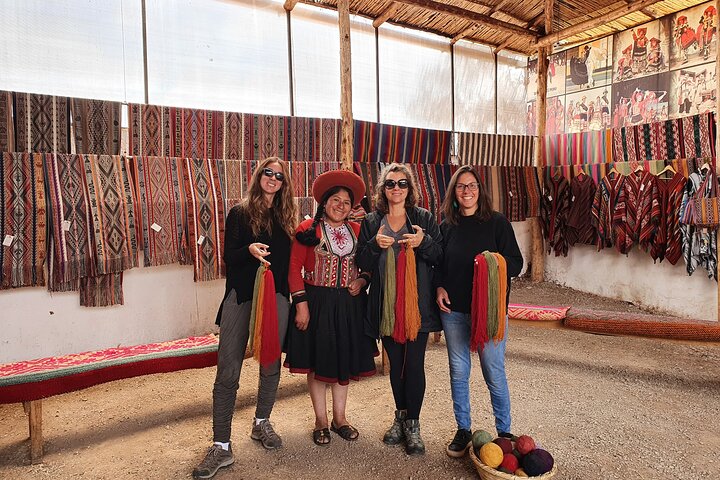
Before heading down (train back, blessedly)—and this is where it all started to tessellate—I'd also done the Textile Workshop Experience in Cusco Region The Textile Workshop Experience in Cusco Region. Barefoot in a highland cottage, handling raw alpaca wool still warm from the animal, mixing dyes from plants and minerals the way weavers have for five hundred years.
Our teacher was a woman named Lidia, and she showed me her hands—calloused, sure, but moving with a precision that looked like prayer. "The textile is a language," she said. "Every colour, every knot—it says something about who we are."
I made a bracelet. It's lumpy and asymmetrical and honestly a bit sad, but I'm wearing it now, and every time I look at it, I remember the sound of the loom, the smell of natural dye, Lidia's patience while I fumbled with alpaca wool like a toddler.
What the Hippy Trail Actually Offers
On my last full day, I did the Sacred Valley Full-Day Tour: Chinchero, Maras, Moray & Ollantaytambo Sacred Valley Full-Day Tour:Chinchero,Maras,Moray & Ollantaytambo—hitting four standout stops in one solid day. Watching weavers at a working textile centre using dye methods their families have maintained for centuries. Standing in Moray's concentric circles of agricultural terraces, marvelling at the engineering. Walking through Ollantaytambo again, but differently—like I was reading a story I'd already started to understand.
Here's what nobody tells you about the hippy trail: it's not about running away from the modern world. It's about slowing down enough that the old world can catch up. It's about letting people who've devoted their lives to understanding something—whether that's ancient cosmology or textile traditions or the precise angle of a water channel—actually teach you.
Peru didn't fix me. I didn't find myself in the mountains, mostly because I wasn't lost—I was just tired, and exhaustion feels like the same thing until you rest.
But I left with both my original flip-flops accounted for (found the first one in a lost-and-found in Lima), calloused feet, a lumpy alpaca-wool bracelet, and the bone-deep understanding that magic isn't a destination. It's what happens when you're willing to move slowly enough to see it.
The mountain—and the people living on it—will take what it needs from you. The trick is showing up without defending every scrap of yourself so fiercely. Let the trip change you. That's the whole point.