The Airport Ride That Changed Everything
I arrived in Hurghada at 11 p.m., half-delirious from a fourteen-hour flight, clutching a printed itinerary and a vague sense that I'd made a terrible mistake coming to Egypt alone. The Private Airport Pickup to Makdi, Sahl Hashish, Elgouna Private Airport Pickup to Makdi, Sahl hashish, Elgouna was supposed to be simple: a driver, a vehicle, thirty-five minutes along the coastal road to my guesthouse in El Gouna.
But simplicity is a luxury for people who aren't looking for stories.
My driver, Karim, was a man of perhaps sixty with weathered hands and a smile that suggested he'd heard every stupid question a Western tourist could ask and found them all deeply amusing. Instead of heading straight to the resort, he took a detour—not malicious, just inevitable—through the sleeping spine of the Red Sea coast. The Mediterranean night air whipped through the open window. We passed fishermen with hurricane lamps, families still awake in roadside cafés, a wedding procession that appeared and vanished like a fever dream.
"You want to see Egypt like Egyptian?" he asked, glancing at me in the mirror.
"Yes," I said, and meant it so fiercely it embarrassed me.
"Then we don't sleep yet."
Cairo's Midnight Curriculum
Three days later, I was in Cairo, where the heat of the day had finally surrendered and the city was doing what it does best: coming alive. I'd booked the Cairo Street Food with a Local Family Cairo Street Food with a Local Family for the evening, which meant starting in Downtown at dusk and working through the medina-adjacent neighbourhoods where tourists rarely venture once the sun dies.
Our guide, Amira, was a woman in her forties with hennaed hands and the confidence of someone who'd spent her entire life moving through these streets unafraid. She collected us from our hotel and walked us straight into chaos: narrow lanes lit by strung bulbs, vendors shouting prices I couldn't parse, the smell of cumin and coriander and hot oil so thick I could taste it before eating anything.
The first stop was a juice cart where an old man with one eye made something from sugar cane that tasted like liquid electricity. The second was a family's home kitchen, where we sat in a living room watching a woman—Amira's sister—make koshari with the efficiency of someone who'd made it ten thousand times. We ate at a shared table, my elbows touching strangers' elbows, everyone talking at once in Arabic and broken English and the universal language of full mouths.
But the real reveal came at midnight, when we ended up in a cramped alley café where men were playing dominoes and smoking shisha, and Amira introduced me as "the writer from France who wants to understand Egypt." A man with gold teeth bought me mint tea. Another told me a story—long, intricate, possibly fictional—about a jinn he'd met in Alexandria forty years ago. I didn't write it down. I just listened. The tea got cold. Time did that thing it does in Cairo after midnight, where it stops meaning anything at all.
The Temples at Dawn (Sort Of)
Luxor demanded a different kind of nocturnal devotion. I'd booked the Full Day Private Luxor East & West Bank Tour With Egyptian Lunch Full Day Private Luxor East & West Bank Tour With Egyptian Lunch starting at six in the morning, which by my increasingly scrambled circadian rhythm felt like midnight.
My guide, Ashraf, was young—maybe thirty—with a degree in Egyptology and a habit of narrating history like he was telling gossip about people he actually knew. We started at Karnak Temple on the East Bank, where the sun was still apologetic and the light turned the carved hieroglyphics into something three-dimensional and alive.
He stood me in the Avenue of the Sphinxes and told me that these stones had been here for 3,500 years. "Do you know what that means?" he asked. "It means the people who built this died so long ago that even the people who conquered Egypt after them are now dead so long ago we forgot their names."
We crossed the Nile by felucca—a wooden sailing boat that moved through the water like something out of a Flaubert fever dream. On the West Bank, we moved through the Valley of the Kings, where the tombs opened into the mountain like mouths, and Ashraf told me about the grave robbers and the archaeologists and the people who'd spent their whole lives trying to figure out what death meant to the ancients.
But here's what nobody tells you: the West Bank at midday is tourist-choked. The real magic happens when you leave the tour groups behind and wander back alone at dusk, when the light is the colour of old copper and the guards are tired and ready to chat. That's when a tomb stops being an attraction and becomes what it was always meant to be: a door to something you'll never quite understand.
The Giza Problem
I'd been avoiding the pyramids like they were a bad review, but eventually I had to confront the thing that had drawn me to Egypt in the first place. The Giza Pyramids, the Grand Egyptian Museum GEM Giza Pyramids, the Grand Egyptian museum " GEM " is the kind of tour that promises efficiency—eight to nine hours, both heavyweight hitters, an Egyptologist guide handling the logistics.
What it actually delivers is the revelation that seeing the pyramids is not about understanding them. It's about accepting that you're standing in front of something that makes your brain go quiet.
We started before dawn to beat the crowds, which worked about forty percent. The pyramids rose up out of the darkness like they'd just decided to exist, and for the first time since arriving in Egypt, I understood why people came here: not for the history, though that's real, but for the vertigo. These stones predate everything you believe about time.
The Grand Egyptian Museum—the sprawling new complex they call GEM—is where they've consolidated Egypt's greatest treasures. We moved through rooms of statues and sarcophagi and the kind of objects that make you realise that vanity is the only eternal human impulse. A guide explained the mummification process in clinical detail while I stared at a face that had been preserved for three thousand years because someone believed they could cheat death.
The air conditioning was aggressive. The crowds were thick. But when you're standing in front of Tutankhamun's burial mask—that golden, slightly arrogant face staring through you—you understand that museums exist precisely because you're not supposed to feel anything except awe.
The Red Sea at 4 a.m.
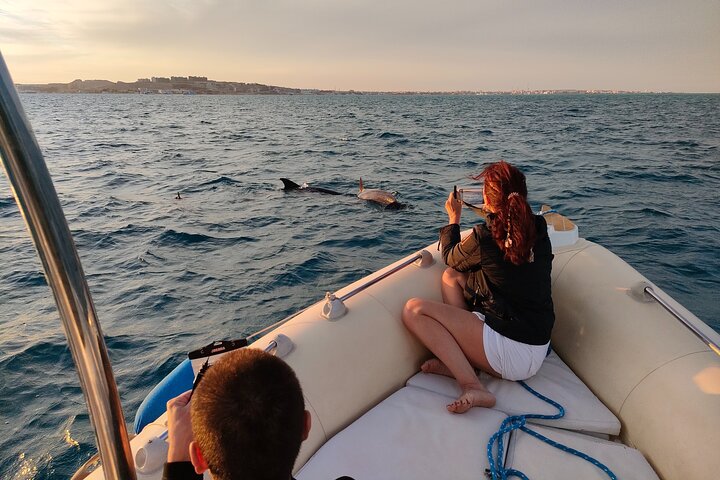
My last morning, I couldn't sleep, so I booked the Private Dolphin Watching And Snorkeling Tour Private Dolphin Watching And Snorkeling Tour for before sunrise. The boat left at four in the morning from El Gouna's marina, and it was just me, the captain, and the Mediterranean holding its breath.
We motored out into the dark, the only lights our boat's running lamps and the stars, which down here are so numerous they almost hurt to look at. The captain was a taciturn man named Hassan who'd been running this route for twenty years. He didn't talk much, which meant I had to sit with the enormity of being alone on the water in the dark.
Then Hassan cut the engine. "Listen," he said.
I heard it before I understood what I was hearing: a sound like someone tapping glass underwater, repeating in patterns. Dolphins. They were hunting the shallows, their clicks bouncing off the sand beneath us. Hassan turned off the lights, and we floated in the dark, listening to a conversation in a language we'd never understand.
When the sun came up, we moved to the snorkelling zones—two shallow reefs scattered with fish so bright they seemed photoshopped. But the dolphins were what stayed with me. Not because they were beautiful, though they were, but because they were utterly indifferent to my presence. They weren't performing. They weren't aware I was watching. They were just living their lives, and I was just a ghost passing through.
The Midnight Mint Tea Epilogue
On my last night, I was sitting in a café in Islamic Cairo, the kind of place where locals outnumber tourists about fifty to one, drinking mint tea at two in the morning and writing in my notebook. A man next to me—a stranger—asked what I was writing.
"The truth," I said, which is what you say when you're delirious with travel and sleep deprivation.
He nodded like this made perfect sense. "In Egypt," he said, "truth is nocturnal. The day lies to you. The night tells you things you don't want to know."
I never got his name. But he bought me another tea, and I stayed until the café owner started sweeping around my feet, a gentle eviction that felt like a benediction.
Egypt didn't reveal its secrets to me. It showed me that some things refuse to be understood, and that's exactly why you come.


