I landed in Mexico City with a vague plan, a beaten backpack, and absolutely no idea how thoroughly I'd botch the next three weeks. That's the thing about solo travel in Mexico: you can research until your eyeballs bleed, but the country has a way of ignoring your carefully highlighted notes and dragging you sideways into something better.
The first mishap came at the airport. I'd booked a hostel in Coyoacán, or so I thought. Turned out I'd mixed up two hotels with nearly identical names, and the taxi driver dropped me at a wedding venue instead. Rather than scramble, I walked to a café nearby, ordered an obscene amount of coffee, and watched Mexico City wake up. A woman at the next table, María, a sculptor, asked why I looked so comically defeated. By the time I finished explaining my numbskull mistake, she'd invited me to a gallery opening that night. That's how solo travel works. You prang the plan, and something better slides in.
I spent my first week chasing the big hitters: the pyramids (I did a Teotihuacán: Private Tour from Mexico City on day two), the museums, the stuff you're supposed to see. But I kept thinking about what lay outside the capital. A mate back in Santiago had mentioned the Yucatán—cenotes, ruins, Caribbean light. Before I left the capital I booked one last big-ticket morning, and after it I bought an overnight bus ticket and pointed myself east.
Sky, Stone, and Altitude Sickness
Once you've seen Teotihuacán from ground level, you think you've got the measure of it. You haven't. The Balloon Flight with Breakfast in Cave and Round Trip CDMX changed how I understand scale and dawn. I was tethered to a wicker basket with six strangers, rising over the pyramids as the sun crept across the valley. The Pyramid of the Sun looked like a thumbnail from ground level; from a thousand feet up, it looked like the heartbeat of an ancient world. The pilot, a calm bloke named Jorge, pointed out details you'd never clock walking around below: the ceremonial complexes, the shadow patterns that only make sense from above, the way the whole city was arranged like a cosmic map.
Breakfast in a cave afterwards felt like something from a fever dream. We landed in a canyon, descended into a cave system that opened onto a stone table laden with fresh fruit, warm bread, and the kind of coffee that tastes better when you've just floated above your own mortality. One woman in our group was celebrating her sixtieth birthday on a solo trip. Like me, she was travelling alone, running on the same fragile courage it takes to climb into a basket and trust a balloon. We talked for hours. That's the real souvenir from that morning: not the photos, but the conversation.
Once the bus had dropped me in the Yucatán, I wanted to tackle the ruins properly before heading to the coast. The Private Chichen Itza Tour with Cenote Swim and Valladolid Visit meant ditching the tour buses and getting my own guide, a young guy named Héctor who carried a quiet authority about the place. No rushing. No herding. Just time to sit with the El Castillo pyramid and actually feel small. We swam in a cenote afterwards, the water so clear and cold it felt like falling through glass. I lost my first flip-flop jumping in, didn't bother looking for it. When you're bobbing in a sinkhole carved by limestone and time, a thong doesn't seem to matter much.
The People Who Turned Up Along the Way
Looking back, the trip is a string of faces more than places. María, who turned my wrong-address disaster into a gallery opening. The birthday woman in the balloon, who told me she'd spent forty years waiting for someone to travel with and finally got bored of waiting. Héctor, who answered my questions about the Maya ballgame with more patience than they deserved. None of them were planned. All of them happened because I was on my own and visibly a bit lost, which, it turns out, is an open invitation in Mexico.
That's the part of solo travel nobody can book for you. You can line up tours, and they're worth it for the access and the guides, but the strangers in between are what you end up telling people about.
When You Swim in Sacred Water and Forget to Worry
Valladolid, the colonial town tucked between Chichén Itzá and the Caribbean, became my unexpected favourite. It's got that faded grandeur: pastel buildings, a central plaza where old blokes play dominoes, the kind of place where tourists exist but don't dominate. I stayed in a converted hacienda, spent an afternoon reading in a hammock, and had a conversation with a barista about the proper way to make café de olla that lasted nearly two hours. This is what solo travel gives you that group trips can't: permission to sit still. To let a place seep in instead of ticking it off.
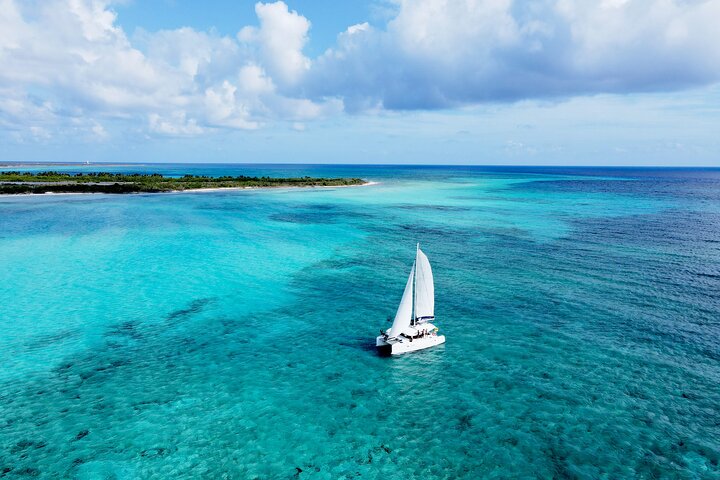
Cozumel called me next. I'd heard the diving was world-class, the snorkelling accessible even for people like me, passable swimmers with sporadic fitness. The Lagoon 39ft Private Catamaran 5hr - El Cielo Full Experience put me on a proper 39-footer with a captain, crew, and the kind of rig that costs actual money. Five hours, just me and a mate I'd met the night before in a beachside bar, a Swiss bloke named Felix who was also running solo. We drew up the route with the skipper, hit three snorkel sites, and barely saw another boat. The water around El Cielo is the colour of lies. Nobody would believe it's real without seeing it. We swam through gardens of coral, watched Nassau groupers hunt, and drifted in silence for stretches. This is where I lost my second flip-flop. It slipped off my foot as I climbed down the boarding ladder and drifted off on the current faster than I could swim. I watched it bob away and laughed so hard I nearly inhaled the Caribbean.
Pushing Inland: Where the Tourists Don't Reach
The resorts and cruise-ship crowds felt suffocating after a week of quiet moments. Felix swore by Baja, so I found a cheap flight across the country to Los Cabos, at the far end of the peninsula, and booked the Hidden Waterfalls Hiking Adventure the night I landed. The 7-hour day promised a canyon descent to a waterfall with genuine solitude. It delivered. The guide, a taciturn bloke named Arturo, barely spoke, which suited me fine. We hiked through dry scrub, picked our way down loose canyon walls, and emerged into a box canyon where water cascaded from a rock face into a pool so clear you could count the pebbles on the bottom.
I swam alone for an hour while Arturo dozed on a rock. No phone signal, no other humans, no choice but to sit with myself and whatever weird thoughts come when you're floating in cold water under a canyon sky. That's the real pull of solo travel in places like Mexico. It strips away the noise and forces you to actually meet yourself. Some people don't enjoy that. I'd been terrified of it. But somewhere between the cenotes and the canyon, I'd stopped being afraid of my own company.
Practical note for anyone tempted to copy the route: Mexico is big, much bigger than it looks on a phone screen. Mexico City to the Yucatán is a long overnight bus or a short flight, and Baja is another flight again. Before you go, read your government's official travel advice for Mexico, keep a photo of your passport somewhere other than your bag, and leave a copy of your rough plan with someone at home, even if, like mine, the plan dissolves by day three.
The Stuff They Don't Tell You About Solo Travel
I've read plenty of blogs and guides. They'll tell you which temples to see, which beaches have the best light, where to find the authentic tacos. What they don't tell you is how often you'll sit alone in a restaurant and feel completely at peace. Or how many times you'll get cheerfully lost in a city and stumble onto something better than what you'd planned. Or how a random conversation with a stranger (a sculptor in Mexico City, a barista in Valladolid, a woman celebrating her sixtieth birthday in a hot air balloon) can reshape how you see yourself.
Mexico taught me that Mesoamerican civilisations weren't just about temples and calendars; they were about people who stood where I stood and wondered about their own place in the cosmos. It taught me that a flip-flop lost in the Caribbean is a small price for the weightlessness of truly being alone. And it taught me that the best travel itinerary is the one you abandon halfway through.
I left Mexico one pair of flip-flops short, a head full of faces and conversations, and a bone-deep sense that the real discoveries happen when you stop trying to find them. That's Mexico for solo travellers: it rewards the ones patient enough to get lost, bold enough to say yes to strangers, and committed enough to float in a balloon at dawn or wade into a cave pool and just breathe.
The chaos wasn't a bug. It was the whole point.


